

21 reflections after a year writing a novel
A few learnings from a year spent writing a novel (among other things)
Welcome entrepreneurs! I’m so glad you’re here.
It’s been nearly a year since my last post, when after five years of regular publishing I decided to take some time off and (gasp) write a novel. So, a year in, I figured I owed you guys an update.
TLDR, I’m 260 pages in, and probably only about 40% done with the story. It’s a behemoth, and I’m fairly certain that I’m going to have to scrub the first 100 or so pages to make it readable.
But on the other hand… I’m writing a fucking novel. Saying that, and it being true, is worth its weight in gold. It feels like coming home to a long lost friend, who’s been waiting patiently and lovingly for me to get my shit together and come hang out (at least when it doesn’t feel like getting my brain slammed under a dumpster lid, which is the case sometimes as well).
Anyway, I missed you guys, so I’m sending a year-end post to fill you in on some of the latest, as well as share a few learnings I picked up along the way in 2025.
(Before that, a quick aside:
We’ve somehow convinced our very own Micah Baldwin to lead the Inside-Out team through a workshop to design our personal goals for 2026.
Of course he then decided to open it up to a handful of additional founders as well.
If you’re interested, you can register below. Nothing over the top, just a structured way to design your goals for 2026 in community. Should be fun, and I’d love to see some readers!
If this is your kind of thing, the workshop is on December 18, from 11am-1:30pm ET, and it’s limited to 30 people. Click here to sign up.)
Anyway, on to my learnings from 2025:
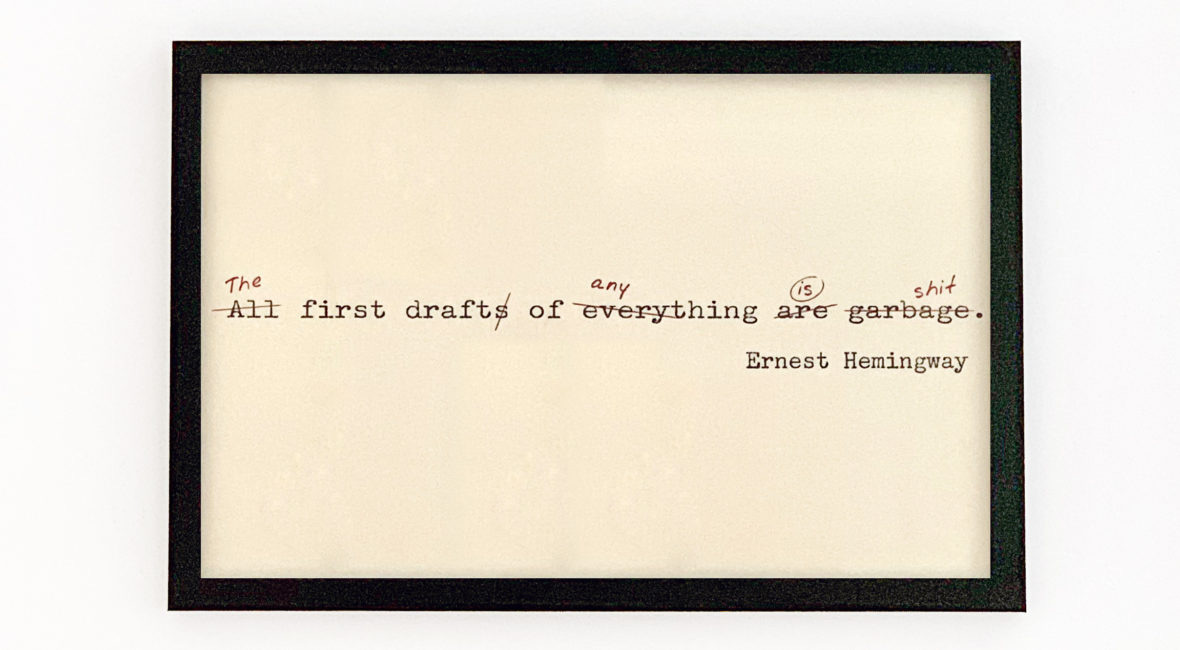
(Image: a favorite piece of art I have in my office these days, from Ryan Holiday.)
On Writing
Every day I sit down to write, I’m doing so to relieve a pressure in my chest, which can only be relieved by telling the story in my head. It’s a productive pressure, which I’ve also learned can be sated by simply talking about the story. This is why, no matter how politely you ask, I am not talking about the book until I’m done with the first draft.
It’s impossible to hold an entire novel in your head (or at least it is for me). Accordingly, my best writing is most clearly correlated with periods of time in which I’m writing every day. With smaller pieces you can write once a week, and as long as you finish the draft in one sitting there’s no issue. With a book of this size, there is no substitute for momentum.
I tried also feeding an outline I wrote into a Claude project, and asking it what I should write about next based on the outline I wrote. But this led to worse writing, and accordingly was more hassle than it was worth.
It is SO, exponentially much easier to write short things than it is to write a long thing. Especially if you’re not talking about it along the way. Imagine working for up to 3 hours per day on something, and then just… stopping. No feedback, no sign that you are on the right track. Nothing. And then, do it again, for 365 days (and counting). Over and over until, some point in the future, you release it and hope it’s good. The motivational arc(s) of this project deserve its own story.
They say you fall in love with your characters. This is true, and evolutionarily necessary for books to exist. If I didn’t love these three dweebs, I would have shelved this puppy long ago.
They say your characters may take you places you didn’t expect to go. This is true, and incredibly inconvenient as it’s caused me to have to throw away large swaths of the outline I painstakingly crafted.
This is the first project I’ve ever worked on in which I don’t care if it’s successful. In fact, I expect it to be mid at best, because that’s the nature of these things. However, I do care if it’s good. I will not stop until it is.
On Business
Around the same time as I let go of the newsletter, I also let go of pushing every day for Inside-Out to grow. Accordingly, we’ve had our best year yet, by a landslide. We’ve grown our book of business significantly, and have also helped multiple clients grow into market defining unicorns. You’d think I’d see this coming by now.
Instead of pushing, I got clear that I wanted the organization to emerge naturally. Not as a result of my effort, but as a result of good people doing the best work they can, and allowing the organization to be a byproduct of that fact. Frederic Laloux’s work was inspirational for me, and I gave it my college best.
Unfortunately, this didn’t work at all for about 8 months. It was a source of incredible frustration for me, and I’m sure those around me.
And then, about 3 months ago, fed up with waiting around for something to emerge, I threw my hands up at emergence and chose to work with JJ to push a project ahead (my rationale being that it could be a precedent for how things emerge, and in any rate something needed to change).
Suddenly, not only did that project get off and running (we’ve just finished our first AI product, a data lake that will underpin the future “cyborg” aspects of our coaching work), but it spawned two other projects. Which then spawned exactly the type of emergent, cocreative dynamics that I was searching for.
It took me some time to understand WTF happened. If my goal is to build an emergent organization, why did I have to push to get things going? My working theory is that there’s something important about source — in this case the founder — that is required to kick start the system. And the timing of that source exiting is critical, because when the source abstains too early, the system is not yet ready to proceed on its own. Tom Nixon helped with this frame, as did my conversation with Peter Merry.
Accordingly, I’m chalking up the first 8 months as me simply being derelict in my leadership, and enjoying the hell out of our newfound jazz band dynamic, now that it’s in swing. I fully expect some very important work to come out of this team in the next year.
On Myself:
I don’t know if I would have otherwise said this, but upon reflection this year brought with it an increased, and new, awareness of mortality. A close family friend, my age, died of brain cancer after an inspirational but ultimately futile battle. My wife’s grandma passed (a 95 year old warrior). My mom was diagnosed with Alzheimers, following a pattern in her mom that I’m sure will eventually be my fate (she’s found medicine that has helped slow things down, thankfully). And at the beginning of the year, I tore my achilles in half, forcing me to confront the end of my athletic abilities, and to be entirely dependent on people around me for a season. I don’t prefer it.
I tend to think of myself as an upbeat, optimistic guy, and others have described me similarly, but there have been times this year when I’ve been really low due to this increased intimacy with death and decay. I think in previous seasons I would have resisted it, put on a happy face. But I’m grateful that I have developed a comfort these days in leaning into the sharp parts, as Pema Chodron says in her amazing book, When Things Fall Apart. This year was hard. And I was here for all of it.
Some of these losses are permanent, and must be mourned. But my achilles tear was temporary. I wouldn’t wish it on anyone, but losing something important and then getting it back definitely brings a sparkle to the thing. The first time I stepped back on a basketball court post surgery was a religious experience. I will never again take my body’s ability to jump for granted. Nor my ability to get a Liquid Death from the fridge for myself.
Related, it turns out (to nobody’s surprise but mine) that I love coaching youth sports. I’m even low key thinking about what it might be like to coach varsity.
I rediscovered an eight page reflection that my grandpa wrote on his life late this year, and it helped me understand and appreciate him in a way I never did when he was alive, and am truly grateful for.
I have been sending my kids emails every so often, to an email address they won’t know they have until their teens or later, for years. I hope my words can have a similar impact, and help them experience me after I’m gone. Perhaps this type of reflection on legacy is the natural turn of one’s mind when faced with its end.
After working out of my home since the pandemic, I am now officially moved into the fifth floor of Bamboo in Grand Rapids. I didn’t realize how much I’d missed people, and plan to be much more around town than I have recently.
If you’ve made it this far, thank you.
Writing this post has reminded me of all the reasons I used to love writing to you all. I think there will be a point in the future in which I rediscover and recommit to this practice, and I truly look forward to that day.
But not yet.
If you liked reading this, feel free to click the ❤️ or 🔄 button on this post so more people can discover it on Substack 🙏
Want to dive deeper?
If you liked this, check out this list of my top posts, read and shared by thousands of entrepreneurs.
Here are a few of my favorites:
The secret to leadership (why authentic leadership is simply more effective)
How to pitch a big vision to investors without setting yourself up to let people down
Executive Coaching for Entrepreneurs
I’m an executive coach and the founder of Inside-Out Leadership, a boutique leadership development agency built by entrepreneurs, for entrepreneurs.
Through a unique combination of deep executive coaching and strategic execution support, Inside-Out has supported entrepreneurs leading some of the fastest growing companies in the world to develop into world-class leaders, and build high-performance, low-drama companies.
We coach leaders how we want to be coached:
Focused on the person, not the role.
Focused on results, without the fluff.
To learn more about working with I-O, click here.
Great to be reading you again, Ryan. Will wait patiently for the novel. Bebe also says hello.
RDH, BWH...and PBC
Fiction! Yes! Congrats on making the jump. I recently finished my debut novel not long ago.
Flow state high in fiction > flow state high in nonfiction